DDQ MON 2020-09-21 @ 12:40 PM
12. Theories & The Seven Stages of Action
12.1. Agenda
General Announcements
CSCI 4800H/6800 Paper Presentations begin THU 2020-10-15.
Term Project: Milestone 2: Definition & Related Work
Activity
12.2. Activity
Duration: \(\sim\) 5-10 minutes
In prior discussions, we talked about design-related guidelines and principles. Today, we are going to discuss theories, which are, “high-level widely applicable frameworks to draw on during design and evaluation as well as to support communication and teaching.”
- framework
A supporting structure around which something can be built. Frameworks are the rules, ideas, or beliefs that are used to plan or decide something.
- theoretical framework
A single formal theory, i.e., the structure that can hold or support a theory of a research study.
When a study is designed around a theoretical framework, the theory is the primary means in which the research problem is understood and investigated.
Notable Examples
Social Cognitive Theory (Bandura)
Seven Stages of Action (Norman)
User Action Framework (Andre et al.)
- conceptual framework
One or more formal theories (in part or whole) as well as other concepts and empirical findings from the literature.
Conceptual framewords are used to show relationships among the various ideas and how they relate to the research study.
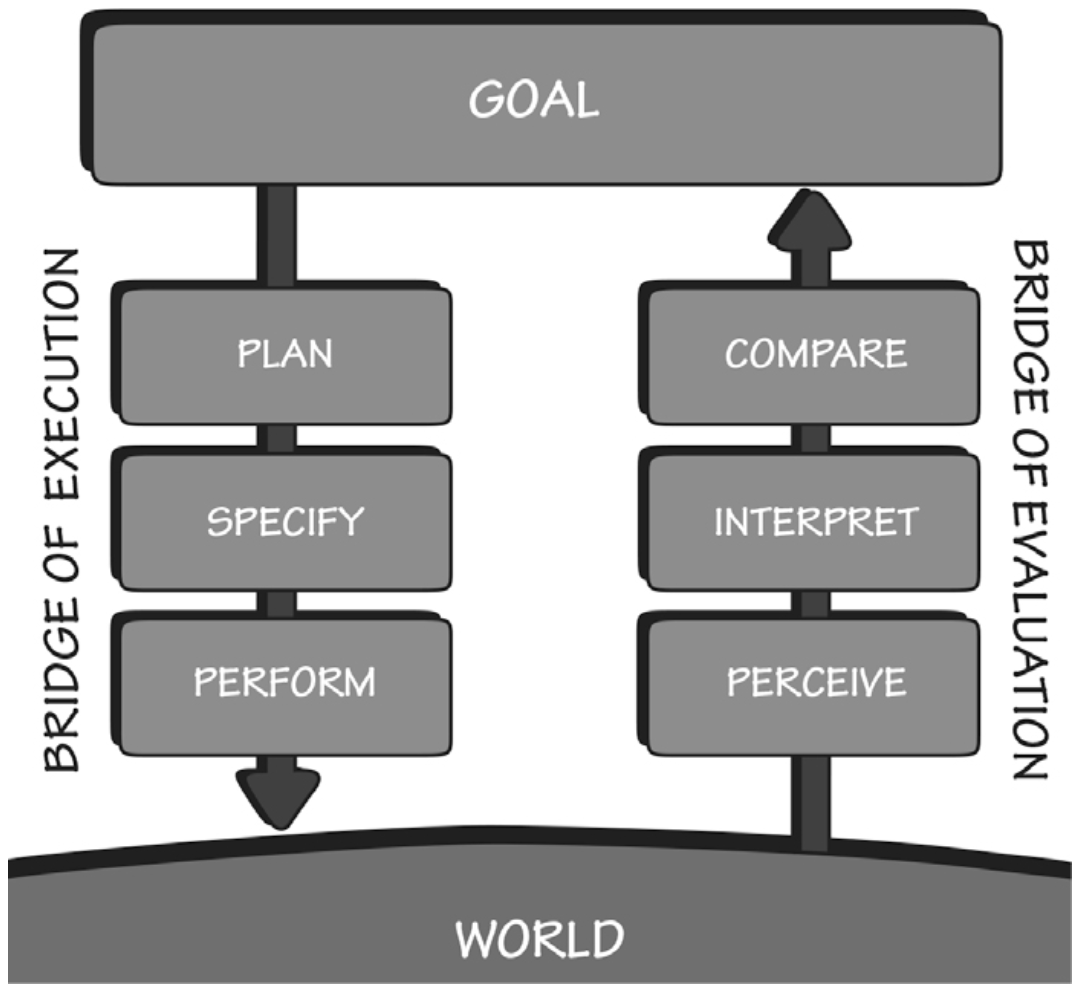
Consider the Seven Stages of Action in Norman’s The Design of Everyday Things [Book:2], an explanatory theory and theoretical framework for human-computer interaction:
For many everyday tasks, goals and intentions are not well specified; they are opportunistic rather than planned.
—Don Norman
12.2.1. Breakout Rooms
Duration: \(\sim\) 15-20 minutes
Quick introductions, if needed.
As a group, respond to the following in a followup discussion here.
Pick and provide a short description of a task that everyone in the group has either directly performed or is familar with and that meets the following criteria:
it involves a computer interface;
there are alternative ways to complete the task (e.g., using different apps, services, hardware, etc.)
Describe your task in terms of the Seven Stages of Action. If there are different responses from different members of the group, then please be sure to note that – it will make the responses more interesting.
- Goal
What are the specific goals each of you have that lead to attempting the task? Are these goals themselves planned or opportunistic?
- Execution
How do each of you plan, specify, and execute the actions needed to accomplish the task? What specific steps might you take to execute the task? Are there any alternatives?
- Evaluation
How do you perceive the results of executing your actions? How much cognitive load is required to interpret the results and why? How do you determine if: i) the task is complete; and ii) your goal is met? Are (i) and (ii) the same thing?
Now that you’ve described your task, comment on each of the following in the context of your task:
The Gulf of Execution; and
The Gulf of Evaluation.
Make sure all group / room members are listed in your followup discussion post.
Pick a group representative. This person will briefly share your group’s conceptual model to the class. No pressure, seriously!
Respond to other followup discussions until the breakout rooms end.
12.2.2. Back in Class
Duration: \(\sim\) 20 minutes
When asked, all group representatives should type
repinto chat.The instructor may ask group representatives to present by name or simply ask that they present in the order they’re listed in chat.