DDQ MON 2020-09-14 @ 12:40 PM
9. Physical Variations and Bias
9.1. Agenda
General Announcements
CSCI 4800H/6800 Paper Presentations
Presentations dates are now scheduled…
Pick paper by FRI 2020-09-18.
Homework 1: Affordances & Signifiers
Consider making it
privatenow, if not already.Complete your final draft by FRI.
Term Project: Milestone 1: Problem Proposal
Get your proposal info posted as soon as possible (definitely before the deadline).
Activity
9.2. Activity
Duration: \(\sim\) 5-10 minutes
In the Handbook of Anthropometry, you can find research and data related to human dimensions, i.e., the measurements and proportions of the human body. For example, in John T. Manning’s chapter, “Sex Differences and Age Changes in Digit Ratios,” the author presents research related to digit ratios, specifically: how they differ by sex; and how some ratios might be linked to different diseases and disorders.
- digit ratio
Often taken to mean the ratio of the lengths of the second and fourth digits (2D:4D).
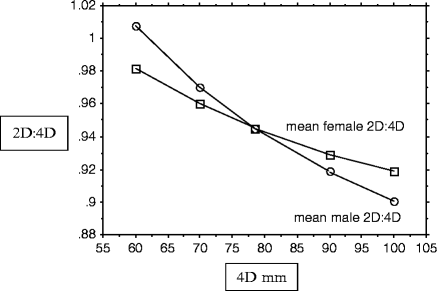
Fig. 9.1 Fig. 48.2: The relationship between 4D length and mean 2D:4D. The sample consisted of 344 males and 404 females. Note that 2D:4D showed no sex difference at the value of 4D where male and female regression lines for 2D on 4D intersect (in this case at 78.47 mm). Below this value of 4D, females had lower 2D:4D than males. Above this value, they had higher 2D:4D than males and the sex difference in 2D:4D increased in size with increasing 4D.
If digit ratios can differ between different groups of users, then they might be worth considering when it comes to planning multi-touch user interfaces (e.g., many touch screens) or even single-touch user inerfaces (e.g., keyboards). The placement of icons, buttons, and other “things” that users must press their fingers against could potentially lead to bias, i.e., the interface design favors some groups of users over others.
What questions should be considered to mitigate biases based on physical variatiosn among our users? That’s the topic of today’s DDQ.
9.2.1. Breakout Rooms
Duration: \(\sim\) 15-20 minutes
Quick introductions, if needed.
As a group, respond to the following in a followup discussion here.
Without realizing it, biases can manifest themselves in our designs. List two or three ways the members of your breakout room might personally but unintentionally introduce bias based on physical diversity into a design.
Search the Web for an example where a human-computer interface failed to respond to some of the physical variations in its users. Provide a link and briefly summarize the scenario, including descriptions of any issues your example caused.
What are some things we should consider to avoid what happened in your example provided in (b)? In other words, how might we preemptively respond to physical diversity in our designs?
Who benefits from these consideration? For each stakeholder you identify, please provide a brief justification.
Make sure all group / room members are listed in your followup discussion post.
Pick a group representative. This person will briefly share your group’s conceptual model to the class. No pressure, seriously!
Respond to other followup discussions until the breakout rooms end.
9.2.2. Back in Class
Duration: \(\sim\) 20 minutes
When asked, all group representatives should type
repinto chat.The instructor may ask group representatives to present by name or simply ask that they present in the order they’re listed in chat.