DDQ MON 2020-08-31 @ 12:40 PM
4. Learning Study Example
4.1. Agenda
General Announcements
Term Project: Milestone 0: IRB Training
Activity
4.2. Activity
Duration: \(\sim\) 5-10 minutes
Today we continue our discussion of Time to Learn by closely examining a real, but limited, learning study of a computer-related interface: the Japanese keyboard available on smartphones. The results of this study can be found in [AUG31:1].
- AUG31:1
Muhammad Suhaib. A Study of the Learning Curve of the Japanese Keyboard on Smartphone. International Journal of Scientific Research & Engineering Trends, September – October 2018. doi:10.2139/ssrn.3409538.
Japanese Smartphone Keyboard
Without getting into too many details, the basic Japanese writing system does not use an alphabet; instead, it uses a syllabary. Each of the basic characters represents a syllable, usually formed using a consonant and vowel. In the figure below, a Japanese smartphone keyboard is depicted. Its design lays out 9 consonants in a 3-by-3 grid. To input a syllable character, users must hold down a consonant to access and specify the syllable’s associated vowel.
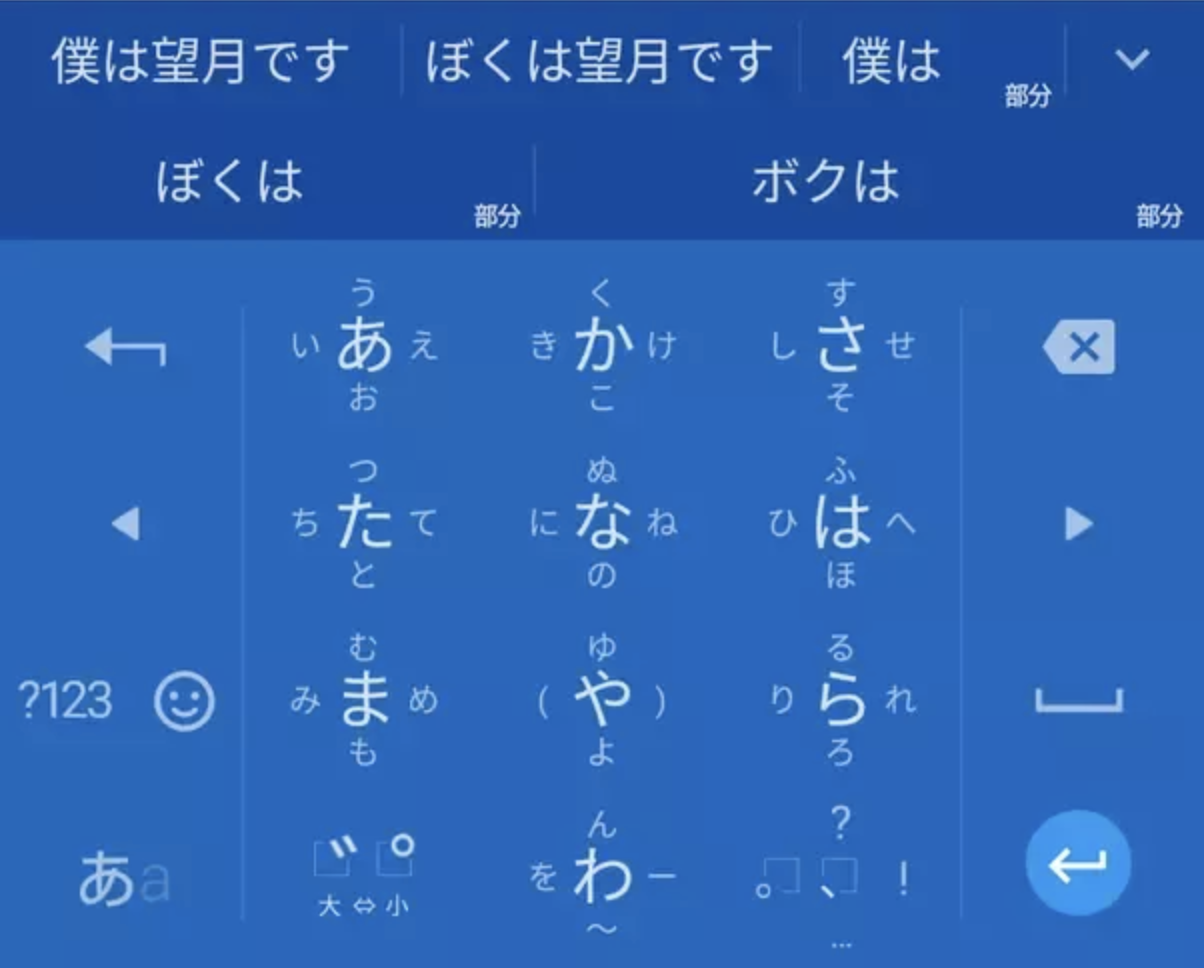
Fig. 4.1 Japanese Smartphone Keyboard
The Study
This study has many flaws; however, its goals are ones that we are interested in. It can be inferred that the main research question is:
How easy is it for a new user to learn the Japanese smartphone keyboard?
4.2.1. Breakout Rooms
Duration: \(\sim\) 10-15 minutes
Quick introductions, if needed.
Read and discuss the paper. It’s less than two pages.
Respond to the following in a followup discussion here.
Describe the interface-related task that users learn in this study.
How does the author measure successful task completion?
How does the author test successful task completion?
Summarize the results of the study.
List three specific ways that the study can be improved and why? If an improvement is related to the experimental design of the study, then be sure to provide more details about that.
Pick a group representative. This person will briefly share your group’s conceptual model to the class. No pressure, seriously!
Respond to other followup discussions until the breakout rooms end.
4.2.2. Back in Class
Duration: \(\sim\) 20 minutes
When asked, all group representatives should type
repinto chat.The instructor may ask group representatives to present by name or simply ask that they present in the order they’re listed in chat.